
Always on: High availability private 5G edge clusters with zero-downtime upgrades
Two or three-node active-active edge clusters and rolling upgrades keep devices connected through hardware failures and maintenance.
Celona edge clusters now stay up through node failures and through upgrades. The 2026.1 AP and Edge release adds High Availability (HA) 2.0 active-active edge clusters and rolling software upgrades for both edge nodes and access points.
On a factory floor, in a warehouse or at a port, the wireless network is part of the production line. AGVs, handheld scanners, cameras and PLCs all expect the network to be there. A failed server or a maintenance window should not stop the shift.
This release is built around that expectation: keep devices connected when hardware fails, and keep them connected while you upgrade.
Every edge node carries live traffic
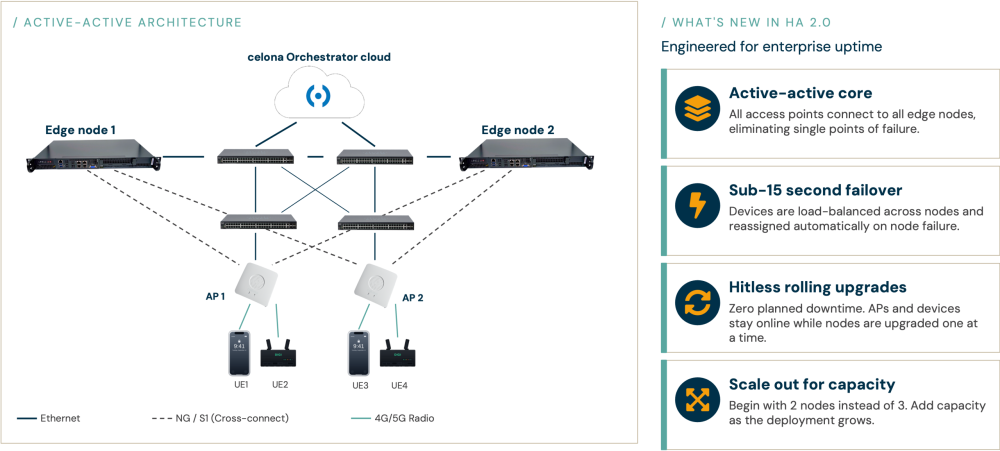
Edge clusters can now run as two- or three-node active-active clusters. Every access point registers with every edge node, and device sessions are load-balanced across all of them. No node sits idle as a standby.
If an edge node, a port or a core service becomes unavailable, affected devices automatically fail over to a surviving node. Traffic resumes in under 15 seconds, measured from the failure to the device passing traffic again.
HA 1.0 versus HA 2.0
| HA 1.0 | HA 2.0 | |
|---|---|---|
| Minimum nodes | 3 | 2 |
| Model | Active-standby control plane | Active-active, load-balanced |
| AP connectivity | One shared cluster VRRP IP | Per-node IP addresses, no cluster VRRP IP |
| Capacity | Leader plus standbys | N+1: every added node adds its full capacity |
A two-node cluster is now a true HA option. That lowers the hardware cost of resilience for smaller sites, while larger sites can add nodes for both scale and redundancy.
Upgrades without a maintenance window
Edge upgrades that roll back on their own
Edge clusters now upgrade one node at a time, so the site keeps serving devices throughout. Before a node upgrades, it stops admitting new device sessions and drains its existing ones to the other nodes.
If any node fails to upgrade, the nodes that already upgraded are automatically rolled back. The cluster never runs mixed software versions, and no one has to untangle a half-finished upgrade at 2 a.m.
Access point upgrades with device handover
Site upgrades now proceed AP by AP. Before each AP upgrades, its connected devices move to neighboring APs. The upgrade waits for that AP to return to service before moving on to the next one.
The result: coverage and sessions hold steady through maintenance. Upgrades no longer need to wait for a plant shutdown or a weekend window.
What you need
HA 2.0 is available on EdgeOS 2026.1 and later, for 5G deployments with AP2x-series access points. Existing HA 1.0 clusters upgrade to EdgeOS 2026.1 with no site reconfiguration. New deployments should select Cluster Scheme V2.
Plan one control-plane IP and one data-plane IP per edge node. A two-node cluster needs two of each; a three-node cluster needs three.
The full details are in our documentation:
/See it in action
Always on, from failover to upgrade day
Watch the Always On demo to see HA 2.0 failover and rolling upgrades in action.