
CURWB versus private 5G: CURWB your enthusiasm
An opinion piece on the wireless connectivity for industrial manufacturing.
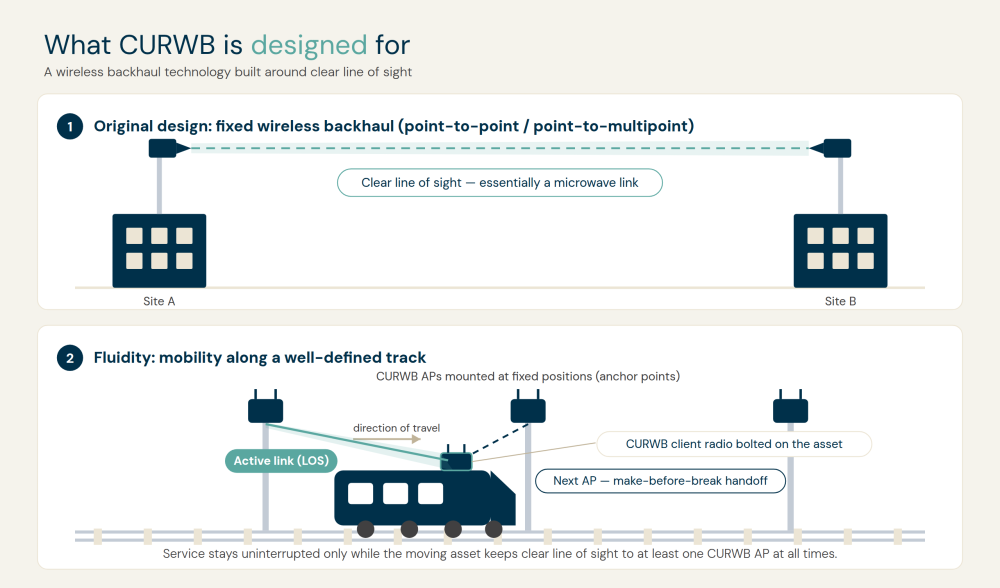
CURWB, short for Cisco Ultra-Reliable Wireless Backhaul, is based on the Fluidmesh technology Cisco acquired back in 2020. It runs in sub-6 GHz unlicensed spectrum on 802.11-class radios, but it doesn't really behave like Wi-Fi. Instead, CURWB uses a proprietary Layer-2 protocol to deliver an MPLS-like forwarding fabric. As the name indicates, it was designed to provide wireless backhaul connectivity between endpoints that are mostly within line of sight of each other.
Recently we have been seeing attempts to position CURWB as an alternative to private 5G for wireless access, particularly for mobility use cases that need mission-critical connectivity. I believe this is not just a marketing mistake but a fundamental architectural error. The longer this perception goes unchallenged, the more time and money wireless networking professionals will waste deploying the wrong tool for the job. At a recent enterprise networking event, the network manager of one of the largest US auto manufacturers openly shared the shortcomings of CURWB that his team learned the hard way, after extensive testing with AGVs in their factory environment. They eventually abandoned the project. Hearing that story convinced me these facts need to reach a wider audience, which is what motivated this blog.
For industrial mobility use cases that require reliable wireless connectivity, the technical issues with CURWB come down to four things:
- It typically requires line of sight (LOS) between the mobile endpoint and the CURWB radio for reliable performance. However, LOS is very hard to guarantee in industrial facilities, even with a dense deployment of APs and using multipath operation (MPO) and mesh routing.
- It is a proprietary technology that only works with Cisco CURWB radios (APs) and wireless clients. No handhelds, tablets, smartphones, third-party AGV modems, or IoT sensors can ever join a CURWB network.
- It uses unlicensed spectrum, same as Wi-Fi, which is exposed to uncontrolled interference. All it takes is one employee's smartphone sending Wi-Fi beacons on the shop floor to hurt the performance of the CURWB network.
- CURWB radios are constrained by the relatively low transmit power limits of unlicensed spectrum, which makes covering large outdoor areas impractical.
CURWB
CURWB runs in sub-6 GHz unlicensed spectrum on 802.11-class radios, but Cisco layers its own proprietary Layer-2 protocol on top to deliver an MPLS-like deterministic forwarding fabric. It ships in two modes. The first is point-to-point or point-to-multipoint, connecting two sites over line of sight on current IW9165/IW9167 hardware. In that mode it is essentially a microwave link, and it competes with Cambium and a dozen other vendors who solve the same problem for less money. The second is what Cisco calls fluidity, the access mode used for moving assets like AGVs, mining trucks, port cranes, and trains. A CURWB wireless client sits on the moving asset and performs a make-before-break handoff between wayside radios as it travels.
The wireless clients it works with are the Catalyst IW9165E, IW9165D, IW9167E/I/E-HZ, and a small handful of Fluidmesh legacy models. That is the entire mobile device universe. There is no handheld, rugged tablet, third-party AGV modem, smartphone, environmental sensor, or PTT radio that can join a CURWB network as a client. If you want to connect something to a CURWB network, you buy a Cisco CURWB wireless client and bolt it onto the thing that moves. And these wireless clients are typically the same hardware sold as access points, at roughly the same price as an actual Wi-Fi AP.
Cisco's own CURWB documentation, including the FM1200 Volo user manual, explicitly recommends clear line of sight between antennas to maintain the reliability necessary for mission-critical video, voice, and data applications. For autonomous-vehicle and mobility deployments, Cisco specifies that maintaining direct LOS and an optimal received signal window (roughly -45 dBm to -70 dBm) is essential to prevent latency spikes and ensure safety-system performance. Cisco does offer Multipath Operations (MPO) to keep at least one radio path clear in dynamic industrial environments, and we will get to that further down.
private 5G
A private cellular network, whether LTE or 5G, is an enterprise-owned cellular network built on 3GPP standards. In the US it most commonly runs on CBRS shared spectrum at 3.5 GHz, coordinated through an authorized Spectrum Access System (SAS). Outside the US, private 5G deployments use dedicated spectrum bands regulated by local government regulators. Devices authenticate with a SIM, get a dedicated subscriber identity, and connect to a packet core that the enterprise owns and operates.
Because it is built on the 3GPP standard, every cellular-capable device in the world is potentially a client: rugged handhelds, push-to-talk radios, AGV cellular modems, environmental sensors, vision cameras, even off-the-shelf iPhones and Android phones. This is a completely different starting point than CURWB.
Private 5G APs covers a much larger area per radio because it is allowed to transmit at much higher power. Typically one private 5G AP covers the area of five to ten Wi-Fi APs in indoor industrial space. On top of that, 5G brings strong SIM-based authentication, strict QoS and slicing engineered natively into the standard, and native mobility handling - something cellular has been doing on Japanese and European bullet trains at 300+ km/h for over a decade.
So how do Wi-Fi, CURWB and private 5G compare?
The following table summarizes the key attributes of each technology:
| What matters | Wi-Fi | CURWB | private 5G |
|---|---|---|---|
| Line-of-sight needed? | No | Yes - design baseline (MPO enables partial NLOS at extra cost) | No |
| Devices supported | Every 802.11 device | Only Cisco CURWB wireless clients | Every 3GPP device |
| Spectrum | Unlicensed | Unlicensed | Licensed/dedicated (e.g., CBRS) |
| Mobility / handover | Mobile device controlled | Proprietary make-before-break | Network infra controlled |
| Authentication | PSK / 802.1X | Controller ACLs / shared credentials | SIM-based 3GPP AKA |
| Best at | Office use and devices w/o cellular support | High-bandwidth video over LOS | Mission-critical and high mobility applications |
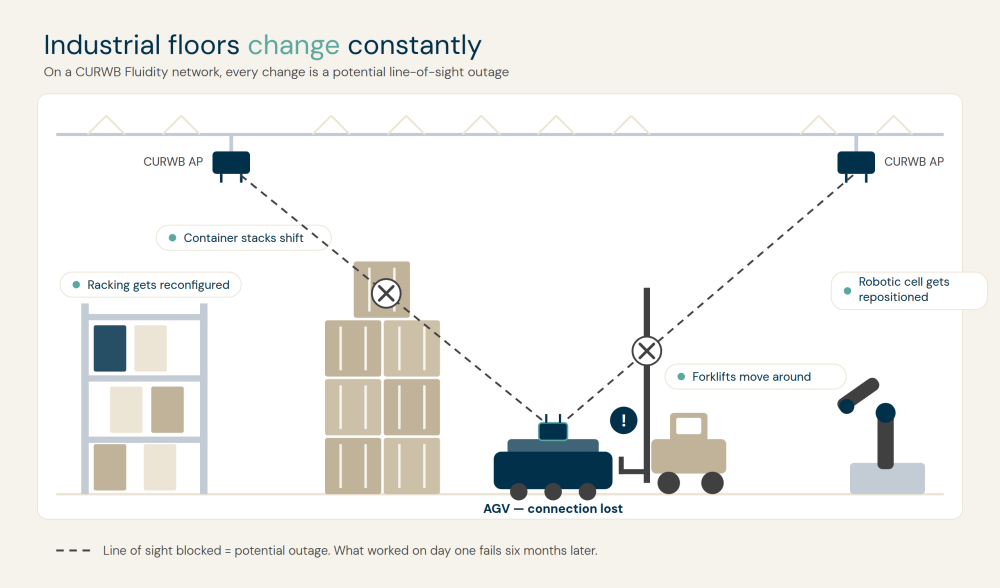
CURWB is engineered around the assumption of a clear line of sight between the wayside radio and the moving asset. Cisco’s own manuals recommend maintaining direct LOS with an optimal signal window to hit the latency and reliability targets they advertise. Cellular technologies like private 5G, by contrast, do not require LOS and never have. This matters because industrial floors change constantly. Forklifts move around, container stacks shift, racking gets reconfigured, and a robotic cell gets repositioned six months after the network goes in. On a CURWB fluidity network, every one of those changes is a potential outage.
CURWB works well in environments where geometry guarantees line of sight: elevated port cranes, mining haul roads, rail wayside. Not surprisingly, Cisco's most credible CURWB references come from exactly those environments. Take that geometry away and drop CURWB inside a real warehouse or factory, and the line-of-sight assumption starts to fall apart.
In response to this challenge, the CURWB solution includes a mechanism called Multipath Operations (MPO). MPO does not remove the line-of-sight requirement; it protects against the moment when the clear path to one AP gets blocked and the client has to rely on another. It does this by duplicating packets: a “protected” packet can be sent multiple times in parallel across uncorrelated paths — different APs, different frequencies, different antenna angles. The first copy to arrive at the egress wins, and the rest are discarded.
In essence, MPO bets that at least one path from the client will have clear LOS to an AP at any given moment. On an industrial floor full of moving structures, winning that bet requires multiple APs with different geometries, and that means a very dense deployment. As you add multiple APs per zone, the capex explodes.
Also, packet duplication carries its own cost. Every extra copy consumes airtime on another channel. In an environment where spectrum is already contested by Wi-Fi devices, spending four to eight times the airtime to buy reliability just adds to the congestion.
So MPO is essentially a workaround. It makes the deployment more expensive in order to solve a problem that cellular solved long ago, and that private 5G solves today with a far smaller infrastructure footprint.
This is the disadvantage that gets glossed over most often. A CURWB network only talks to Cisco CURWB radios and clients. No handheld, tablet, smartphone, or push-to-talk radio can join the CURWB fabric itself; it is a purpose-built network, mainly for AGVs and similar vehicles.
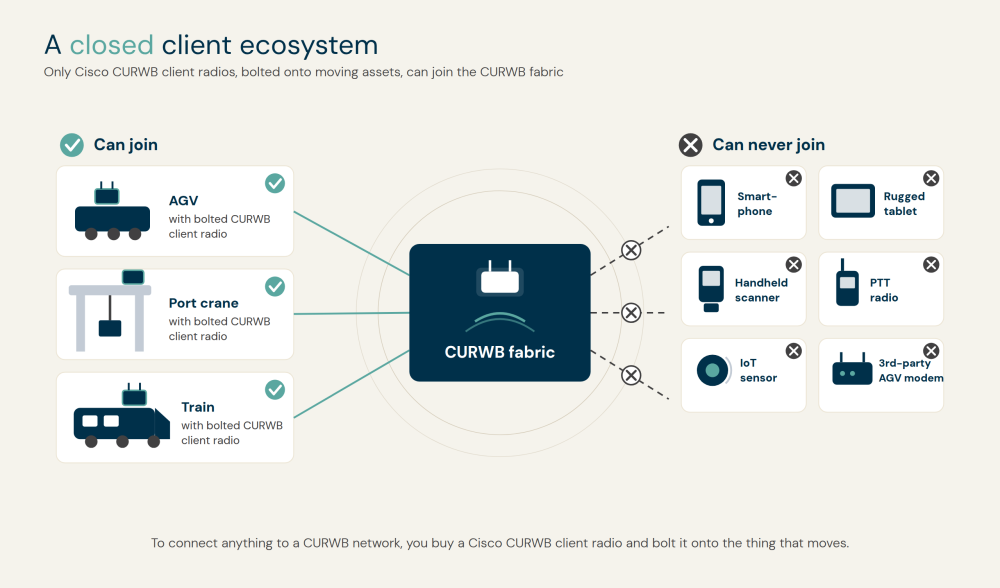
Cisco has recently narrowed part of this gap on the infrastructure side. Selected Catalyst APs can run Wi-Fi 6/6E and URWB at the same time, with roles assigned per radio and managed from the same wireless LAN controller. That removes the need to deploy separate Wi-Fi and CURWB APs, albeit with a price premium. Handhelds and tablets connect to such an AP as Wi-Fi clients, while the deterministic CURWB fabric remains reserved for Cisco CURWB client radios bolted onto moving assets. And since the Wi-Fi and URWB radios now operate side by side in the same unlicensed bands, they compete for the very spectrum the mission-critical traffic depends on.
Unlicensed spectrum bands such as 2.4, 5 and 6 GHz have strict transmit power limitations enforced by regulations. This becomes a serious limitation for outdoor deployments.
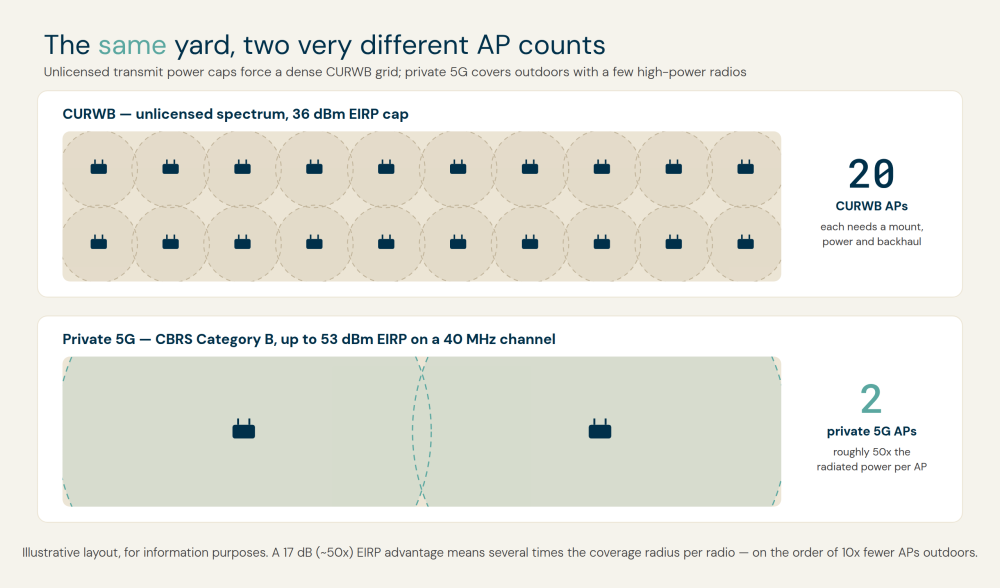
For example, in the US, the FCC limits the maximum EIRP for outdoor deployments in unlicensed spectrum to 36 dBm (4 Watt) EIRP. In contrast, outdoor private 5G APs (Category B) in CBRS band can transmit at 53 dBm (200 Watts) on a 40 MHz channel. This is 50x transmit power difference between the APs of the two technologies translate into significant coverage range benefit for private 5G. For CURWB covering large outdoor areas is only practical in placed with clear line of sight and high-gain directional antennas without mobility.
CURWB authentication is not a modern OT security story. Radios join a network using shared credentials at the controller layer, with ACLs and MAC-based lists as the primary access control. There is no per-device tamper-resistant credential, and no mutual cryptographic authentication between the radio and the network core. If a CURWB radio is stolen off a vehicle, its credentials could be extracted and reused. If a shared credential leaks, the whole network is exposed. In an OT context where the wireless link carries safety and control traffic, that is a meaningful attack surface.
Private cellular takes a different approach, using 3GPP AKA (Authentication and Key Agreement). Every device carries a physical or embedded SIM with an immutable, tamper-resistant identity. Authentication is mutual: the device authenticates the network and the network authenticates the device, through a challenge-response derived from a key that never leaves the SIM. If a device is stolen, the operator revokes the SIM in the packet core and the device is off the network immediately, everywhere. This is the same authentication model that protects mobile banking and government identity credentials on billions of devices worldwide.
Wi-Fi and other technologies have used unlicensed spectrum successfully for decades, and regulators have opened up a lot of new unlicensed spectrum in the 5 GHz and 6 GHz bands in recent years. Wi-Fi is an excellent connectivity option that works on a best-effort basis and can often deliver very high data rates. But guaranteeing QoS with strict SLAs on packet loss and jitter is a different matter entirely, and in unlicensed bands it becomes very challenging.
As mentioned earlier, CURWB runs in sub-6 GHz unlicensed bands. Any device with Wi-Fi, Bluetooth, BLE, or Zigbee in the vicinity contends on the same spectrum. For a network carrying safety signaling or autonomous-vehicle telemetry, that is a real exposure.
This is a good place to bring back the network manager from the large US auto manufacturer I mentioned at the start. His team deployed CURWB in their discrete manufacturing environment and tested it for almost two years. His summary was blunt: “Under ideal conditions you can get 2 ms latency with zero packet errors with CURWB. But CURWB operates in unlicensed spectrum, and you cannot control interference in the 2.4 GHz, 5 GHz, or 6 GHz bands. All it takes is somebody walking by with a mobile hotspot to disrupt the CURWB network.” His most memorable example was a group of employees running a karaoke machine near the factory floor during an employee event. The karaoke system happened to operate in the same unlicensed spectrum, and it generated enough interference to knock the CURWB network sideways.
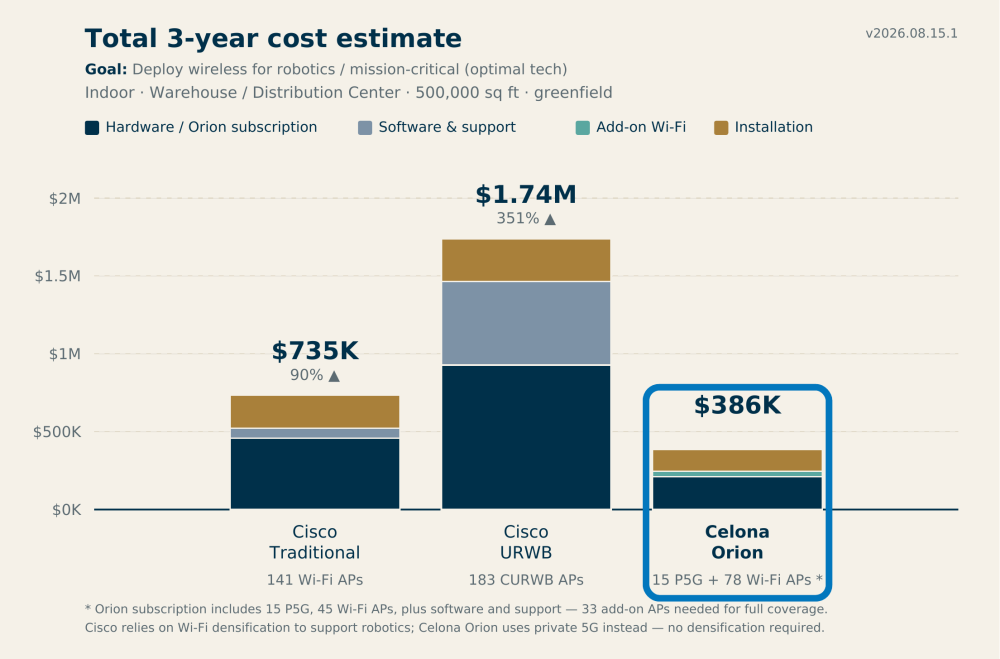
Below is the the estimated costs of supporting robotics and mission critical work-loads at a 500,000 sq-ft Warehouse using the pricing estimator
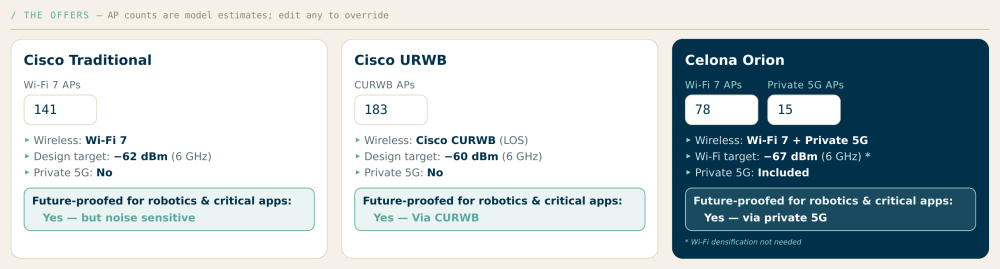
Wi-Fi 6 GHz deployment for robotics will need 141 APs with a design target of -62 dBm, whereas a CURWB design will require additional APs to maintain line of sight to each robot. Our models for CURWB, at a −60 dBm RSSI design target( as recommended by Cisco), will require 183 APs. A Celona private 5G design for the same area will only require 15 private 5G APs. With the additional APs, the cost of installation, software and support scale as well driving the cost of ownership significantly.
With Celona Orion subscription, while mission critical robotics are designed to run on private 5G, additional Wi-Fi APs are provided at no cost for legacy Wi-Fi devices on the factory floor.
Where CURWB deserves its due is high per-link throughput for video aggregation in line-of-sight environments. The canonical example is a rail yard or port with ten cranes carrying eight cameras apiece — a serious bandwidth load, enough to push the limits of a single 5G cell. Elevated vantage point, guaranteed line of sight, no handhelds in the picture, and all the aggregated traffic lands on one CURWB backhaul link. CURWB fits that job well.
But notice what that use case is: backhaul. It is in the name of the product. CURWB does exactly what it was designed for, which is wireless backhaul for elevated, line-of-sight, high-bandwidth assets. The trouble starts when it gets stretched into being an access network for a moving warehouse robot.
My answer, for the overwhelming majority of industrial manufacturing environments, is Private 5G, because the architecture requirements are quite clear once you write them down:
- Manufacturing floors are dynamic. Production lines reconfigure, materials and racking move, robotic cells get repositioned. A technology that depends on unbroken line of sight cannot survive that operational reality. Private 5G stays predictable through it.
- Manufacturing needs a solution that can serve many device classes at once: AGVs, AMRs, handhelds, push-to-talk radios, vision systems, sensors, supervisor tablets. All of it belongs on one access network with one security plane and one policy model. Private 5G can serve all of those device classes.
- Mission-critical workloads belong in protected spectrum. CBRS and licensed bands are interference-protected by regulation; unlicensed bands are not. Machine control and safety signaling should not be sharing airtime with the consumer phones on the shop floor.
- Security and identity matter. SIM-based mutual authentication is an enterprise-grade identity plane; shared credentials and controller ACLs are not. The wireless layer has to hold up to the same auditability standard as the rest of the enterprise LAN.
- Standards-based futureproofing matters. Private 5G is open 3GPP, with a multi-vendor ecosystem and a clear path to 5G-Advanced and 6G. CURWB is one vendor, one proprietary protocol, one roadmap. That is a strategic risk.
- Total cost adds up fast with CURWB. A high density of APs plus specialized CURWB mobile clients on every asset can make both deployment and operation very expensive.
CURWB earns its place in a narrow band of use cases adjacent to manufacturing: elevated, line-of-sight-guaranteed, high-bandwidth backhaul or asset access in ports, mines, rail yards, and a handful of fixed assembly-line situations where the topology is truly stable. Anywhere else, choosing CURWB over Private 5G is picking a scalpel for a job that calls for a multi-tool.
Go deeper
More resources on private wireless for the enterprise.