
More network for your dollar
How Celona Orion gives you a better network for the same or lower price than the leading enterprise Wi-Fi vendor.
These days the answer for any new wireless initiative seems to deploy more Wi-Fi APs. For example, assume you plan to upgrade to Wi-Fi 7 and add robots to your network. This quickly turns into a Wi-Fi densification project. More APs, more cable, more cost – still with limited reliability and mobility for the robots in the unlicensed spectrum.
Celona Orion enables you to run mission critical devices such as robots on the deterministic private 5G network and provides Wi-Fi 7 network in the same bundled subscription for the other devices such as scanners, tablets and people.
Fewer number of APs, one network to secure, and the right network for the right traffic. All managed on a single platform. Upgrading a 500,000 sq ft warehouse with Celona Orion lands at roughly half the cost of traditional Cisco Wi-Fi and under a fifth of Cisco URWB — this is two networks from Celona still much cheaper than Cisco Wi-Fi or CURWB.
The false choice
Over the last few years private 5G has emerged as the leading way to deliver mission-critical connectivity for these environments and workloads. Given the advantages of cellular wireless connectivity in terms of range and mobility, it is the natural candidate for the new class of automated workloads.
That does not mean Wi-Fi goes away. A complete transition of a facility from Wi-Fi to private 5G would require moving every device to a 5G-capable version. That is unnecessarily costly, and in some cases there is simply no cellular equivalent for a general-purpose enterprise device.
So, the customer ends up buying and operating two networks: Wi-Fi and private 5G. Worse, cellular offers from traditional telco vendors are not only 5–8× the cost of Wi-Fi for a similar facility, but also demands completely new infrastructure: dedicated fiber, dedicated switches, routers and new security systems. No wonder private cellular has stayed a niche option.
Celona Orion
When Celona first emerged, we tackled that problem with an enterprise-grade private 5G solution that works with existing enterprise network and security infrastructure, at a price point comparable to Wi-Fi. It is one of the main reasons the platform has been adopted by over 220 enterprise customers, with more than 45 of them Fortune 500/Global 2000, across manufacturing, logistics, retail, transportation, energy and healthcare.
With Celona Orion we take the next step and tackle the cost and complexity of running two separate networks. The way we do it is simple: we include Wi-Fi in the existing private 5G subscription. No extra cost. You scale as you need: run mission-critical workloads like robotics on private 5G while continuing to use Wi-Fi for existing Wi-Fi-only devices and for future applications best suited to Wi-Fi.
Wi-Fi "included" versus "add-on"
A single per-5G-radio subscription gives you one 5G access point plus three or four Wi-Fi access points "included" with hardware, software and support all covered by the one subscription.
- Option 1 — one 5G AP plus four 2x2 Wi-Fi 7 APs.
- Option 2 — one 5G AP plus three 4x4 Wi-Fi 7 APs.
If a site needs more Wi-Fi APs than the bundles above provide, the remainder are "add-on" Wi-Fi APs: standalone Celona Wi-Fi 7 SKUs, 2x2 or 4x4, that are also all-inclusive and purchased per AP. In every scenario below the Celona price is bundles plus any add-ons. There is never a separate software or support line item.
We use list prices for an apples-to-apples comparison. Many of you hold special discounts with the traditional vendors, and we are glad to engage on your specific situation. We use Cisco as the representative vendor given its market-share-leading position; there may be subtle differences with other vendors, but we expect the trend to hold. Celona pricing includes every component of a complete end-to-end solution: hardware, software and product support.
| Offer | Hardware, 2X2 | Hardware, 4X4 | Software and Support | What the price covers |
|---|---|---|---|---|
| Cisco traditional Wi-Fi | $1,680 | $3,250 | $460 | Hardware, software and support billed separately |
| Cisco URWB | $2,740 | $5,040 | $870 (2x2) / $2,930 (4x4) | Hardware, software and support billed separately |
| Celona Orion | $795 add-on AP | $1,095 add-on AP | Included | $12,000 per 5G subscription bundle, all-inclusive: one 5G AP plus four 2x2 or three 4x4 Wi-Fi 7 APs |
Full list of competitor models and pricing assumptions can be found on the Pricing Estimator page.
How the AP counts in this paper are modeled
/ 01 Calibrated propagation models
Coverage uses an ITU-style indoor path-loss model with venue-specific coefficients, calibrated in two stages: first against professional predictive RF design scenarios spanning 5 GHz, 6 GHz and CBRS, then against many production deployments, including indoor sites across big-box retail, distribution, manufacturing and healthcare.
A grid-edge correction accounts for partially wasted perimeter cells, which matters most on smaller sites.
/ 02 Design targets
Mission-critical robotics Wi-Fi designs target −62 dBm RSSI at the cell edge; standard Wi-Fi designs target −67 dBm. Cisco URWB designs target −60 dBm RSSI at the cell edge, which also aligns with the line-of-sight requirement Cisco recommends.
Private 5G designs target −97 dBm RSRP, which aligns well with a high-availability RF design: even if one 5G AP fails, other 5G APs at the site cover that area.
/ 03 2x2 versus 4x4 access points
The 2x2 or 4x4 choice is about capacity, spatial streams and MU-MIMO headroom, not coverage. Both classes are modeled with the same cell sizes, so the AP count does not change.
What changes is price. It selects the hardware tier for the Wi-Fi vendors and, on the Celona side, which bundle applies: four 2x2 APs, or three 4x4 APs, per 5G subscription. High-density client environments with heavy wireless traffic generally justify 4x4; many industrial deployments are well served by 2x2.
/ 04 Venue types
RF behaves very differently by venue, so the model uses a calibrated propagation profile per venue type. Manufacturing floors, large open halls with long sightlines, propagate best and need the fewest APs per square foot: roughly 7,500–8,500 sq ft per Wi-Fi AP in a mission-critical design. Warehouses and distribution centers, with dense racking, land in the middle at roughly 4,000–4,500 sq ft per Wi-Fi AP. Big-box retail, with merchandising and shelving, is denser still at roughly 2,500–3,000 sq ft. Hospitals are the extreme case: dense interior walls drive the highest attenuation and densities near 1,000 sq ft per AP, consistent with healthcare design norms of roughly 1,000–2,000 sq ft per AP.
The same venue profiles drive the private 5G counts, which is why the Wi-Fi-to-5G AP ratio varies by environment: roughly 7–10× in warehouses and big-box retail, and closer to 7× in hospitals, where Wi-Fi and 5G suffer the wall losses together.
A 500,000 sq ft warehouse, three ways
We use a warehouse and distribution center of 500,000 sq ft to show how Celona Orion pricing compares with Cisco pricing in the pricing estimator. The calculation is run for both brownfield and greenfield deployments, with multiple options.
Warehouse - Brownfield - Option 1
Upgrade existing 5 GHz Wi-Fi wireless for robotics
Warehouse - Brownfield - Option 3
Upgrade dense 5 GHz Wi-Fi to 6 GHz (mission critical)
Warehouse - Greenfield
Deploy wireless for robotics (new install)
Customize with the pricing estimator
Model your own floor - area, device mix, refresh path - in the pricing estimator. Compare Celona private 5G vs. Wi-Fi and private cellular alternatives with your real numbers.
Try the pricing estimatorWarehouse - Brownfield - Option 1
Upgrade existing 5 GHz Wi-Fi wireless for robotics
Warehouse - Brownfield - Option 3
Upgrade dense 5 GHz Wi-Fi to 6 GHz (mission critical)
Warehouse - Greenfield
Deploy wireless for robotics (new install)
Customize with the pricing estimator
Model your own floor - area, device mix, refresh path - in the pricing estimator. Compare Celona private 5G vs. Wi-Fi and private cellular alternatives with your real numbers.
Try the pricing estimatorSelect sections below for more details on each scenario
Brownfield option 1: general-purpose 5 GHz Wi-Fi today, add robotics
INDOOR · WAREHOUSE / DISTRIBUTION CENTER · 500,000 SQ FT · 4x4 WI-FI · 6 GHZ AT 80 MHZ · BROWNFIELD, 67 EXISTING APS
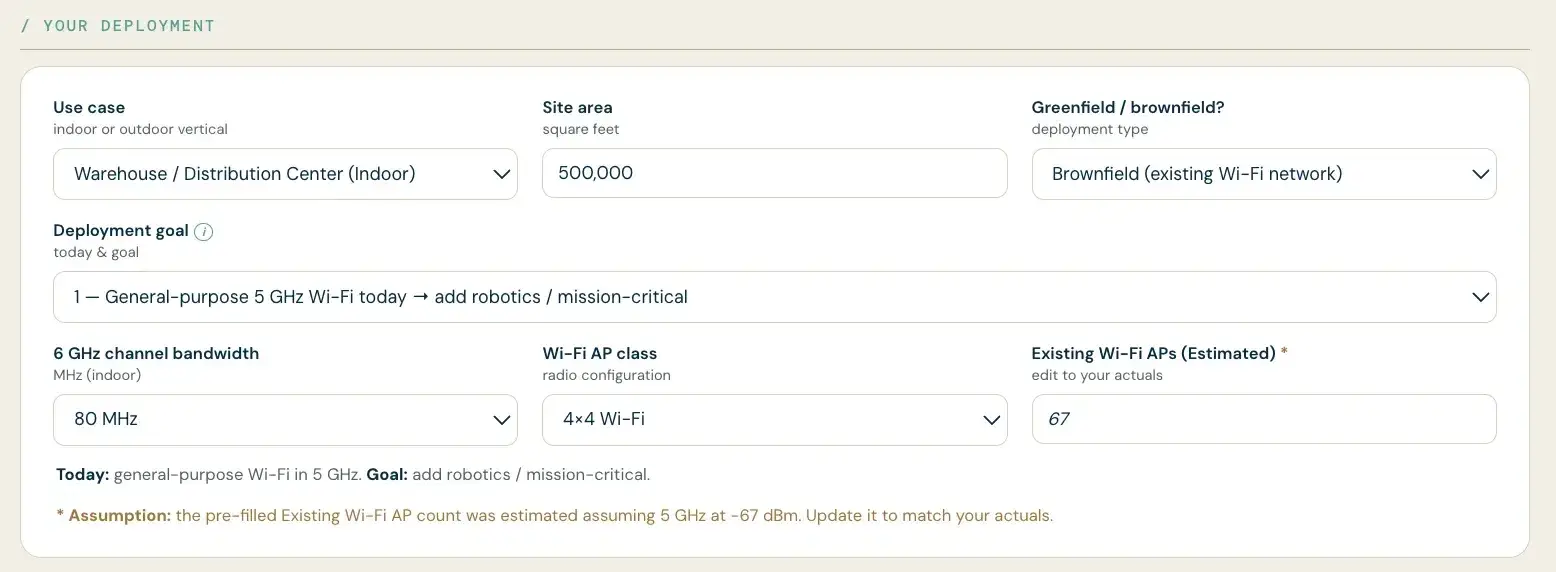
This case assumes the customer is running general-purpose best-effort Wi-Fi, modeled at −67 dBm, and wants to add robotics, AGVs or other mission-critical applications. The comparison shows what that upgrade really costs each way. Here is how the calculator inputs look:
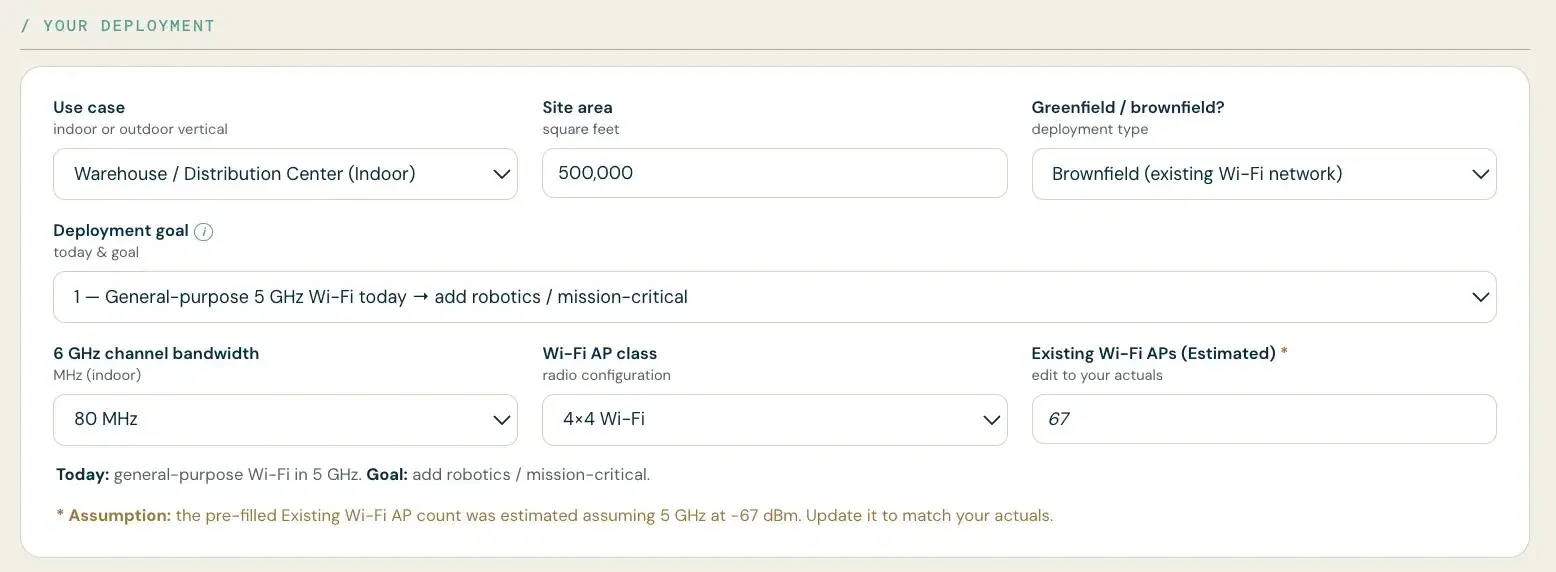
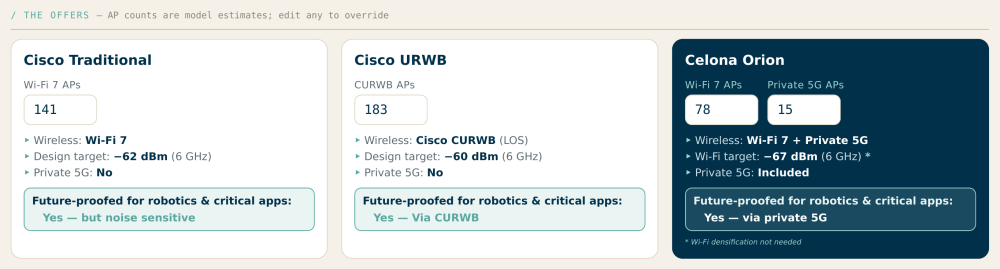
The tool estimates 67 existing Wi-Fi APs from the path-loss model and the −67 dBm criterion for this use case. Every parameter above is configurable, so you can tailor it to your own site. For this configuration, here are the APs each offer requires:
Cisco traditional Wi-Fi, when adding robotics
The main challenge mobile robotics introduces into a Wi-Fi network is holding a consistent connection while moving between access points. Designers answer that by making cells denser, so the device is always close enough to an AP for a good connection. Often that is still not enough: you also have to tune handover behavior on each device, which is more art than science.
We are restricting this article to price points, not the effectiveness of the technologies, so we follow industry design guidelines for density and use them for the pricing. With the inputs above, the calculator recommends 141 Wi-Fi 7 access points across the 2.4, 5 and 6 GHz bands, and cabling for 74 new AP locations (141 total minus 67 existing).
Cisco design with URWB
To work around the mobility problem, Cisco offers a proprietary solution called CURWB, Cisco Ultra-Reliable Wireless Backhaul. To keep this article's scope on pricing we will hold our opinion on proprietary technology in these scenarios; spoiler alert, we believe in standards-based solutions.
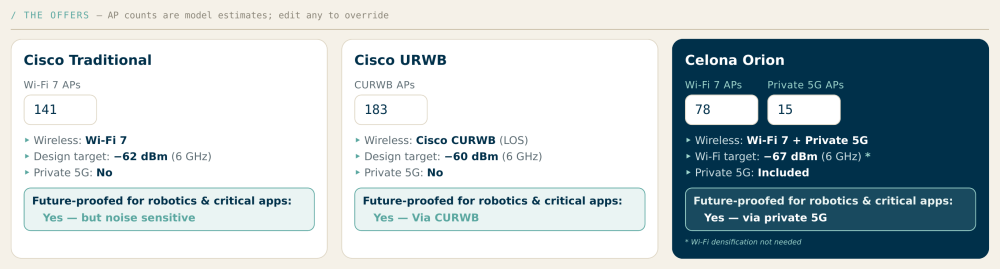
Per the published design guidance, additional APs are required to maintain line of sight to each robot. Our models, at a −60 dBm RSSI design target, end up requiring 183 APs, and cabling for 116new AP locations.
Celona Orion
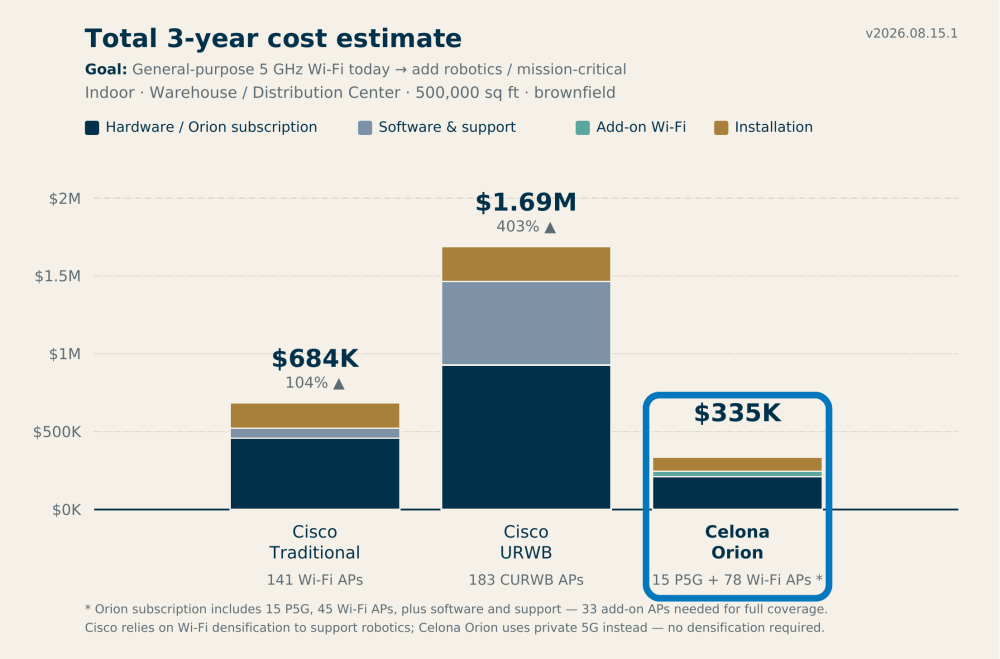
The Celona approach is to satisfy the robotics requirement on the private 5G network and still provide full Wi-Fi 7 coverage for everything else. Private 5G coverage for the robotics application on this facility takes 15 5G access points. With robotics moved to 5G, the Wi-Fi layer no longer needs mission-critical densification: a standard-coverage design predicts roughly 78 Wi-Fi 7 APs at 6 GHz, against the 67 Wi-Fi 5/6 APs assumed at 5 GHz today. That means:
- 15 Celona private 5G APs, whose bundles include 45 Celona Wi-Fi 7 4x4 APs.
- 33 add-on Celona Wi-Fi 7 APs.
- Cabling for 11 new Wi-Fi AP locations, plus the 15 new 5G AP locations.
The calculator assumes existing APs are already connected to PoE switches, so the Wi-Fi 7 upgrade reuses cabling wherever it can.
Cisco traditional Wi-Fi, at $704K, runs more than twice the Celona offer at $320K. Cisco URWB, at $1,152K, runs more than three times it. Here is the breakdown:
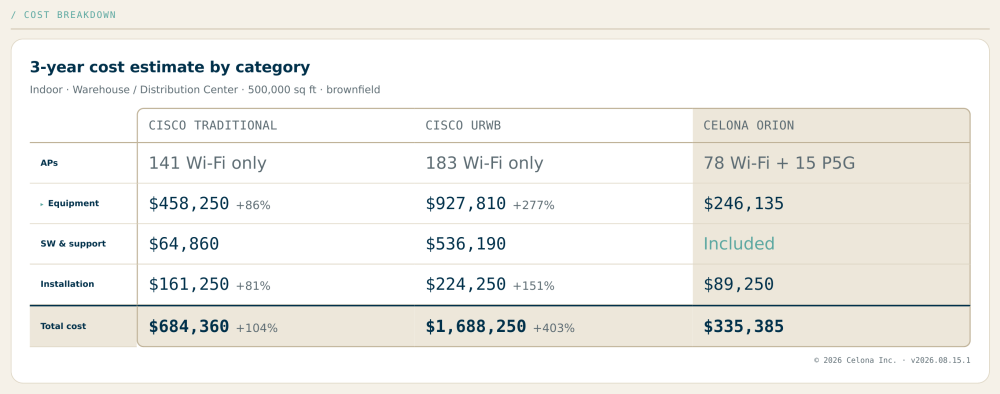
The reason the converged network avoids the large Wi-Fi densification is that it uses the right technology for the right use case: 5G carries the robotics workload, and Wi-Fi carries every other device. Installation is modeled at $1,500 per new AP location and $750 per existing location; the pricing estimator lets you change any of those numbers.
You might think the gap is mostly down to the higher Wi-Fi AP count on the Cisco side. It is not. The gap holds even when the Wi-Fi AP counts are matched, which is the next case.
Brownfield option 3: dense 5 GHz Wi-Fi for critical apps today, upgrade to 6 GHz
INDOOR · WAREHOUSE / DISTRIBUTION CENTER · 500,000 SQ FT · 4x4 WI-FI · 6 GHZ AT 80 MHZ · BROWNFIELD, 121 EXISTING APS
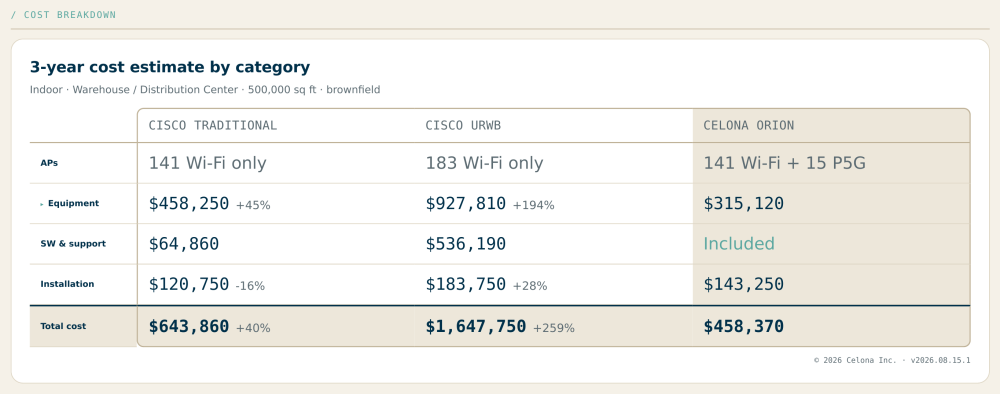
Here the customer already runs a dense 5 GHz network optimized for mission-critical robotics, modeled at −62 dBm, and wants to upgrade to Wi-Fi 7 at 6 GHz while continuing the robotics application.
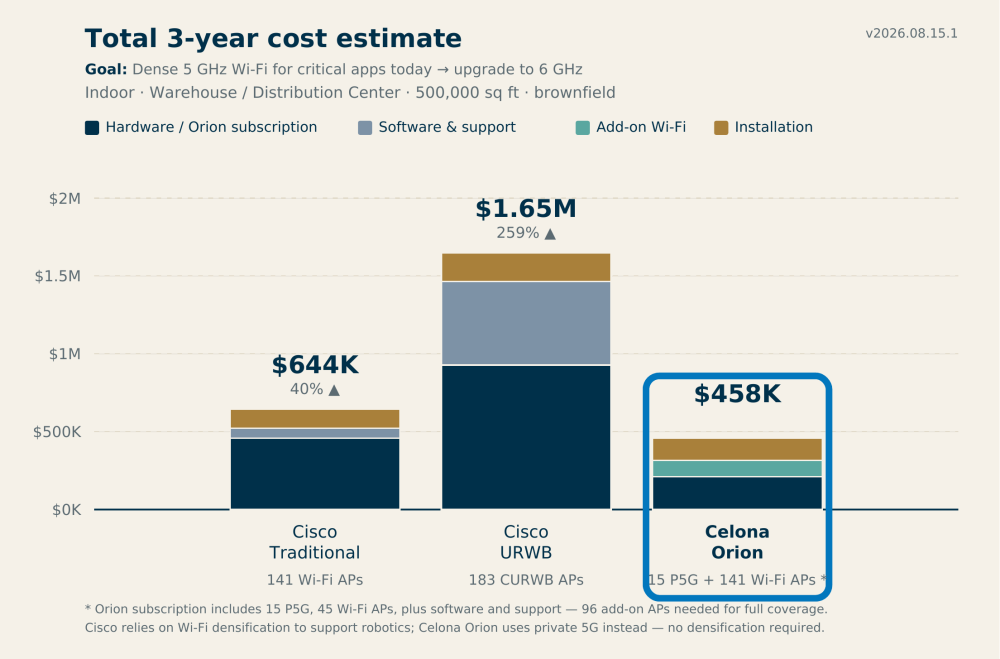
The model predicts 121 Wi-Fi 5/6 APs at 5 GHz today; moving to 6 GHz operation adds about 15% for 141 Wi-Fi 7 APs. URWB still needs 183 APs because of the −60 dBm RSSI requirement.
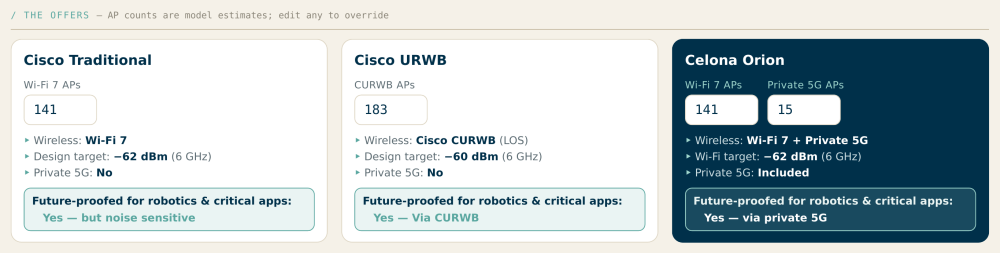
Both the Cisco traditional offer and the Celona offer deliver the same 141 Wi-Fi 7 APs here, so the only interesting question is cost. Cisco traditional still runs 1.5× the Celona offer, and URWB 2.5×.
Greenfield: deploy wireless for robotics from scratch
INDOOR · WAREHOUSE / DISTRIBUTION CENTER · 500,000 SQ FT · 4x4 WI-FI · 6 GHZ AT 80 MHZ · GREENFIELD
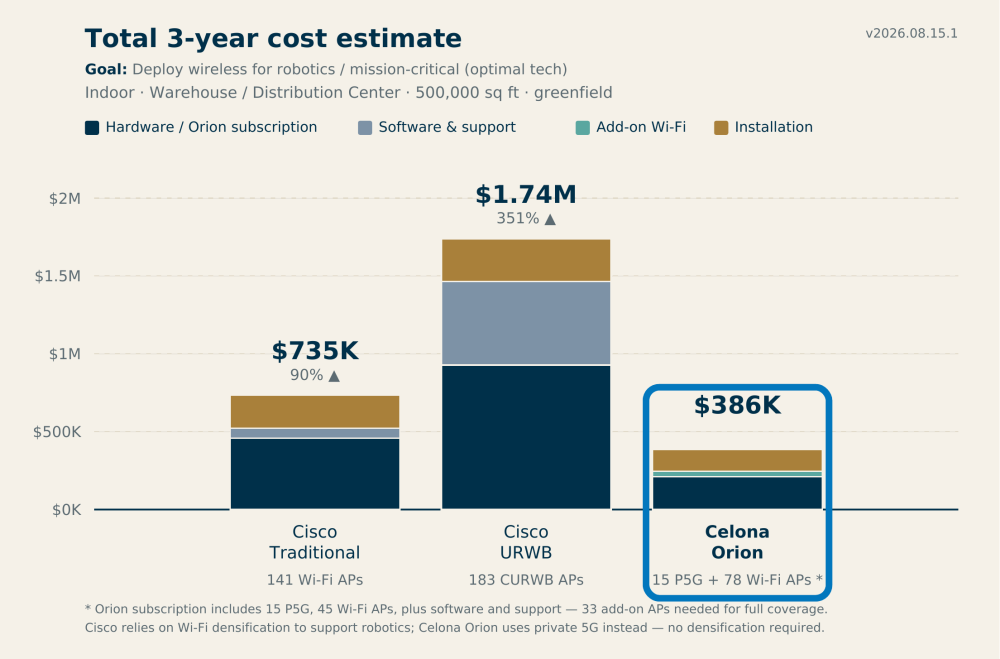
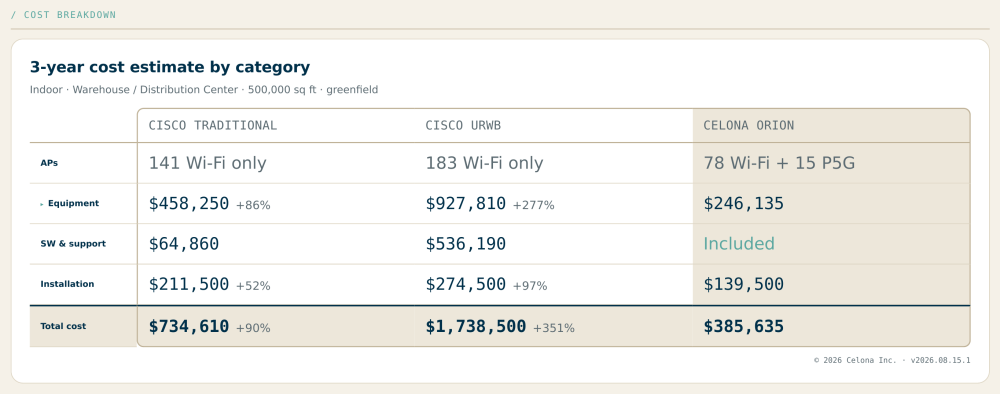
The greenfield case is a simple variant of the first one. The comparison logic is the same, but no existing cabling can be reused by either option. Celona's Wi-Fi layer can again be sized to a standard-coverage design, 78 APs at 6 GHz, because robotics runs on private 5G from day one. The Cisco options must still be designed to mission-critical density: 141 APs, or 183 for URWB. Cisco options still cost more than twice as much.
/Conclusion
The right technical decision and the right economic decision
There are many technical advantages to a converged network, and we would never recommend a solution to a customer merely because it is cheaper. The point of this article is that the economics agree with the architecture.
We believe Celona Orion represents disruptive innovation: a better network that costs you less. Across every scenario we modeled on the same 500,000 sq ft site, the converged network came in well under a Wi-Fi-only design, while also delivering private 5G for the workloads that need it:
- Brownfield, adding robotics to general-purpose Wi-Fi — $335K against $684K for Cisco traditional and $1,690K for URWB.
- Brownfield, matched at 141 Wi-Fi 7 APs — $458K against $644K and $1,650K.
- Greenfield — $386K against $735K and $1,740K.
Your situation will have variances: a different vendor, different requirements, other variables. So, in the spirit of full transparency, we are opening the pricing model. The wireless pricing estimator lets you enter your own venue type, site area, 6 GHz bandwidth, use case, greenfield or brownfield, and even your own per-AP prices, and make the comparison yourself.
Go deeper
More resources on private wireless for the enterprise.