
Partner Spotlight: Celona + Relay
Push-to-talk only works if the signal does. See how Celona private 5G and Relay keep frontline teams connected across plants, yards and warehouses.
The challenge: staying connected in industrial environments
For the people who keep a plant, refinery, or warehouse running, radio communication is how work gets done. Two-way radio remains the most common way frontline teams stay connected, letting them coordinate as they move between production lines, cross outdoor yards, and drive forklifts from one end of a facility to the other.
Yet industrial facilities are also among the most challenging radio environments on earth. Many are built in remote, rural areas where land is available but public cellular coverage is often patchy. Campuses can stretch across millions of square feet, and the dense metal in buildings and equipment makes it even harder for radio signals to travel. In some places the conditions are extreme: at steel plants, IT teams have seen Wi-Fi access points melt when placed too close to molten steel.
Worker mobility makes all of this even harder. Frontline teams rarely stay in one place, so their devices are constantly facing unreliable hand offs between Wi-Fi access points or from Wi-Fi to cellular as they move in and out of buildings. Wi-Fi's lower transmit power makes it unreliable for workers on forklifts covering large facilities or working outdoors. Blanketing a site with more access points quickly drives up costs. Public cellular, meanwhile, sits outside the enterprise’s control: reliability varies with distance to the tower and network congestion, and building materials and obstructions weaken the signal.
The result is connectivity dead zones, and their impact goes well beyond inconvenience.
- Safety. A worker who can't reach anyone is at risk. In a plant that is loud, hazardous, and spread across acres, being able to call for help can be the difference between a near-miss and an incident.
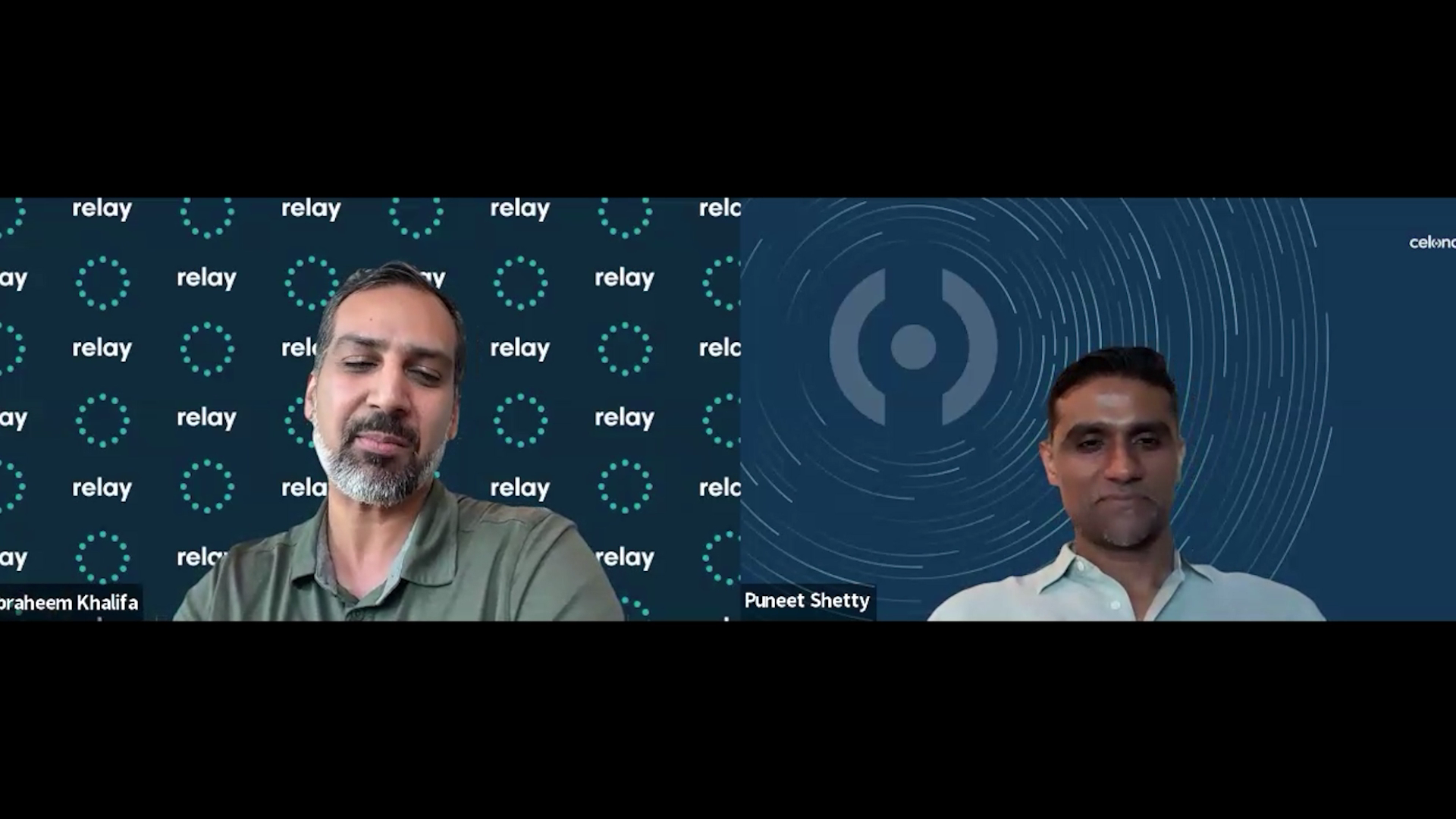
- Trust. "If there's even one message that doesn't make it through in a critical moment of coordination, that becomes a real challenge, and it erodes trust in the system," says Ibraheem Khalifa, Principal Product Manager at Relay.
- Efficiency. Dead zones leave operations with an incomplete record of what happened on the floor. For enterprises rolling out connected worker programs, dead zones also set a ceiling on what any frontline technology can deliver. Workers may carry high-end tablets, but if those devices lose connection the moment they head outside, teams fall back to pen and paper.
Why private 5G for push-to-talk?
Private 5G gives industrial organizations a cellular network of their own. They no longer have to rely on a public network they don't control or push Wi-Fi beyond its design limits. Celona delivers enterprise-grade private 5G through its Orion converged wireless platform, which brings private 5G, Wi-Fi, public cellular, and satellite together in a single deterministic, secure fabric.
"Coverage, mobility, and reliability are probably the three pillars which clearly differentiate private 5G as the wireless technology of choice for critical applications," says Puneet Shetty, SVP of Product and Field Engineering at Celona.
- Coverage. Private 5G extends reliable connectivity across large indoor and outdoor areas, including spaces that were previously unconnected.
- Mobility. Cellular technology was designed for mobility. It's why you can stream video or join a call on a moving train. Private 5G brings the same capability to an industrial site, so workers stay connected as they move on forklifts both inside the warehouse and in outdoor yards.
- Predictable performance. Critical voice applications require deterministic latency and performance. Because a private 5G network belongs to the organization, it is isolated from the shifts in demand and capacity that affect public networks, and it adds the security of an enterprise-controlled network. The network is reliable enough that some customers now run programmable logic controllers (PLCs) over private 5G instead of cable, so it can easily handle critical voice.
Wi-Fi still has a place. In a dispatch center, where people stay at their desks, Wi-Fi works very well. Orion's converged approach means each device can use the connection that suits it, without the organization managing separate networks, vendors, and contracts.
How Relay is modernizing push-to-talk
Relay is the system of action for physical operations, built for the large share of the workforce that doesn't sit behind a desk. Nearly 10 percent of the Fortune 500 use Relay, across nearly 10,000 sites. Rather than asking frontline workers to adopt new habits, Relay keeps the interface they already use: a ruggedized push-to-talk radio. A worker wearing protective equipment in a loud facility can't easily stop to type into an app, but they can press a button and talk.
What has changed is what happens next. Relay's system captures and organizes spoken observations from frontline teams. It transcribes messages, layers in insights, and turns what workers say into action within the systems the enterprise already runs. Real-time translation across 35 languages, powered by AI models tuned for manufacturing, keeps multilingual crews coordinated. Built-in safety features, including panic alerts and location context, help supervisors respond quickly when a worker needs help.
Traditional radios offered limited recording capabilities at best, and few workers want to type detailed notes into a screen-based connected worker solution after a 10- or 12-hour shift. With Relay, they talk as they always have, and those conversations become shift reports, summaries, and actionable insights.
None of this works without reliable connectivity, and Relay has spent years building for it. Relay has deep roots in the cellular space and has evolved its connectivity approach from a single-carrier SIM to multi-profile SIMs and eventually to a Dual SIM Dual Standby device with its latest hardware.
As customers began adopting private wireless, Relay saw that private 5G could slot straight in, giving customers a connection isolated from the unpredictability of public networks and under their control. "Push-to-talk is valuable because you're moving around," says Khalifa. "You're wanting to communicate with folks as you're walking from your trailer into the steel plant. These are the scenarios for which we built our system, and private 5G is such a great technology to enable all these benefits."
How Celona and Relay work together
Celona recognized early that a network is only valuable when the devices and applications on it deliver results. That's why it launched its 5G LAN device certification program more than three years ago to test the devices and applications customers depend on. More recently, shared customers brought Celona and Relay together, and the partnership followed naturally.
Relay devices have been thoroughly tested and fully certified on Celona's private 5G network, so they work out of the box with no interoperability risk. Because Relay devices already support multiple connectivity modes, private 5G fits straight in, and Celona is a first-class citizen in Relay's configuration.
"You pop in your SIM card, flip a switch, and Celona will just work," says Khalifa.
Once Relay devices are on the network, Celona's MicroSlicing™ technology can prioritize push-to-talk traffic, so voice messages get through even when the network is busy with video, sensor data, and other applications.
The result is a joint solution in which each company does what it does best. Celona provides the converged wireless foundation, with private 5G, Wi-Fi, and public cellular, plus satellite integration, from a single vendor, one budget line, and one place to troubleshoot. Relay provides the communications platform that frontline teams use every day.
That combination is already at work at a leading U.S. food manufacturer, where frontline teams needed push-to-talk that stayed connected as they moved between buildings and outdoor areas. With Celona private 5G covering the site and certified Relay devices running on it, workers can now reach their teammates wherever they are, and supervisors get a clearer record of what happens on every shift.
Celona AerFlex further simplifies private 5G deployments by eliminating the need for on-site edge servers. Combined with satellite backhaul, the Celona + Relay solution can extend reliable communications to remote locations, including warehouses, outdoor yards, oil rigs, and mining operations.
Customers benefit from safer, more connected industrial operations
Together, Celona and Relay provide industrial organizations with push-to-talk communication that combines the reliability of a traditional two-way radio with the intelligence of a modern platform, across the entire site.
- Improved worker safety. Workers can reach someone wherever they are in the facility, including outdoor yards and metal-heavy buildings where connectivity has traditionally been difficult. Panic alerts and location context help keep them safe.
- More reliable communications. Continuous coverage across the industrial footprint helps messages get through when it matters most, and teams can trust the system they depend on.
- Better coordination. Real-time translation keeps multilingual crews on the same page, while supervisors get actionable insights from the conversations happening every shift.
- Greater operational efficiency. The observations, handoffs, and judgment calls teams make every shift become a ground-truth record of the work, rather than disappearing at shift change. On the IT side, certified devices simplify deployment, and a converged platform replaces separate budget lines, vendors, and contracts. Budget already set aside for a Wi-Fi refresh can instead fund a single converged platform that delivers both Wi-Fi and private 5G at a lower cost for critical applications like Relay.
Relay is part of Celona’s technology alliance program. Learn more at https://celona.io/alliances and https://celona.io/5g-lan-device-certification.
Go deeper
More resources on private wireless for the enterprise.