
/ Case Study | Healthcare | Stanford Health Care
Stanford Health Care: Enhancing Cellular Connectivity with Celona Neutral Host
Stanford Health Care, a leading academic medical center in the Bay Area, faced critical connectivity challenges due to poor indoor cellular coverage - impacting clinical communication and patient safety across its facilities. Celona’s Neutral Host enhanced both private clinical workflows and public cellular coverage within the hospital environment.
6,000
unique connections per day
30-50%
lower cost than traditional DAS
60+
APs across 6 buildings
30%
less cabling & hardware anticipated
Neutral Host for indoor cellular coverage across a major medical center.
_01 The Challenge
Inadequate in-building cell phone coverage, with modern energy-efficient buildings blocking outdoor signals.
_02 The Solution
The Stanford IT team explored the solutions available on the market and ultimately selected Celona Neutral Host.
_03 The Outcome
- 6,000 unique connections per day on the private 5G network
- Enhanced physician and staff communication
- Four more facilities scheduled to go live by mid-2025
- Support for additional carriers and migration of devices from Wi-Fi to private 5G
One of the biggest challenges we have is we don't have good cell phone coverage in our buildings. When buildings are built to be more energy efficient, they block all those outdoor signals.
- Christian Lindmark, VP/CTO, Stanford Health Care
We have roughly 6,000 unique connections a day as people transition from the outside network to the private 5G network internally, and it's working beautifully.
- Christian Lindmark, VP/CTO, Stanford Health Care
Challenge and business requirements
Stanford Health Care, a leading academic medical center in the San Francisco Bay Area, serves approximately 1.5 million patients annually. The organization operates two major hospitals, six ambulatory facilities, and over 150 family clinics. For years they faced a challenge with inadequate cell phone coverage within their buildings, impacting staff, patients and visitors.
Modern energy-efficient construction materials blocked outdoor cellular signals from reaching inside, often leading to dropped calls and communication disruptions for doctors and clinicians. Connectivity inside elevators was even worse. This posed serious risks, as clinicians missed critical calls and text messages, leading to operational inefficiencies and potentially negative patient outcomes.
Traditionally, Stanford Health Care had relied on Distributed Antenna Systems (DAS) to improve coverage, but these solutions were costly and lacked transparency into network usage and performance. With one of their newer hospitals in the East Bay suffering from poor coverage and physicians voicing their frustrations, Stanford Health Care sought a more efficient, cost-effective, and scalable alternative.
Solution
The Stanford IT team explored the solutions available on the market and ultimately selected Celona Neutral Host. Celona's private 5G-based architecture enhanced both private clinical workflows and public cellular coverage within the hospital environment.
Celona Neutral Host is a private 5G-based network that can be easily deployed at any healthcare facility, even in hard-to-reach areas. The same infrastructure can provide full-strength cellular coverage for T-Mobile and AT&T subscribers and can support private wireless use cases for operations and business critical applications.
We have roughly 6,000 unique connections a day as people transition from the outside network to the private 5G network internally, and it's working beautifully.
- Christian Lindmark, VP/CTO, Stanford Health Care
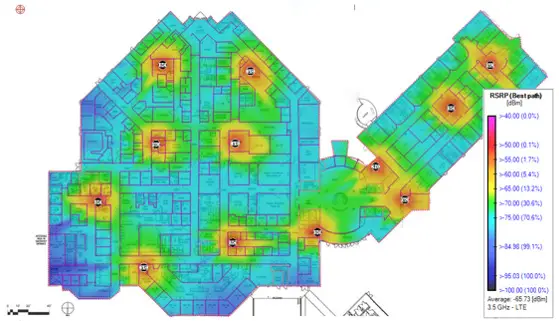
The first phase of the Celona Neutral Host deployment at Stanford included just over 60 Celona access points providing coverage across 6 buildings. Celona Multi-Operator Exchange (MOXN) was activated to establish a secure tunnel between the Celona private 5G network and the AT&T and T-Mobile core networks.
Key benefits of the solution
- Seamless public cellular coverage: Celona Neutral Host allows AT&T and T-Mobile subscribers to automatically transition from outdoor networks to the Celona Neutral Host network within the facility, ensuring uninterrupted cellular coverage.
- Cost savings: The implementation cost of Celona's solution was 30-50% lower than a traditional DAS system, eliminating expensive carrier negotiations and infrastructure investments.
- Operational efficiency: Unlike traditional DAS, Celona's solution provided visibility into activity on the network, helping Stanford Health Care optimize network usage.
- Sustainability: By reducing reliance on wired infrastructure, Stanford Health Care anticipates a 30% reduction in cabling, network hardware, and associated power and cooling requirements.
Outcome
The deployment of Celona Neutral Host at Stanford Health Care has delivered significant improvements:
- 6,000 unique connections per day on the private 5G network, with seamless transitions from outdoor to indoor connectivity.
- Enhanced physician and staff communication, reducing missed calls and texts, improving patient care and operational efficiency.
- Scalability and expansion: Stanford Health Care is expanding the solution to additional buildings, with four more facilities scheduled to go live by mid-2025.
- Future-proofing infrastructure: The private 5G-based network allows for future expansion, including support for additional carriers and the migration of mobile carts and biomedical monitoring devices from Wi-Fi to private 5G.
Next steps and conclusion
Stanford Health Care plans to continue expanding the use of Celona's Neutral Host technology across more facilities, aiming for over 50,000 devices connected to the network in just the next year. By leveraging Celona's solution, Stanford Health Care has significantly improved both public and private network coverage, ensuring a better experience for doctors, clinicians, and patients. This innovative approach positions Stanford as a leader in adopting next-generation connectivity solutions in healthcare.
With this solution, we eliminate months of carrier negotiations and hundreds of thousands of dollars in costs.
- Christian Lindmark, VP/CTO, Stanford Health Care

| At a Glance | |
|---|---|
| Customer | Stanford Health Care |
| Vertical | Healthcare |
| Location | San Francisco Bay Area |
| Facility | 2 hospitals, 6 ambulatory, 150+ clinics |
| Staff | 18,000+ employees |
| Solution |
|---|
|
Go deeper
More resources on private wireless for the enterprise.